
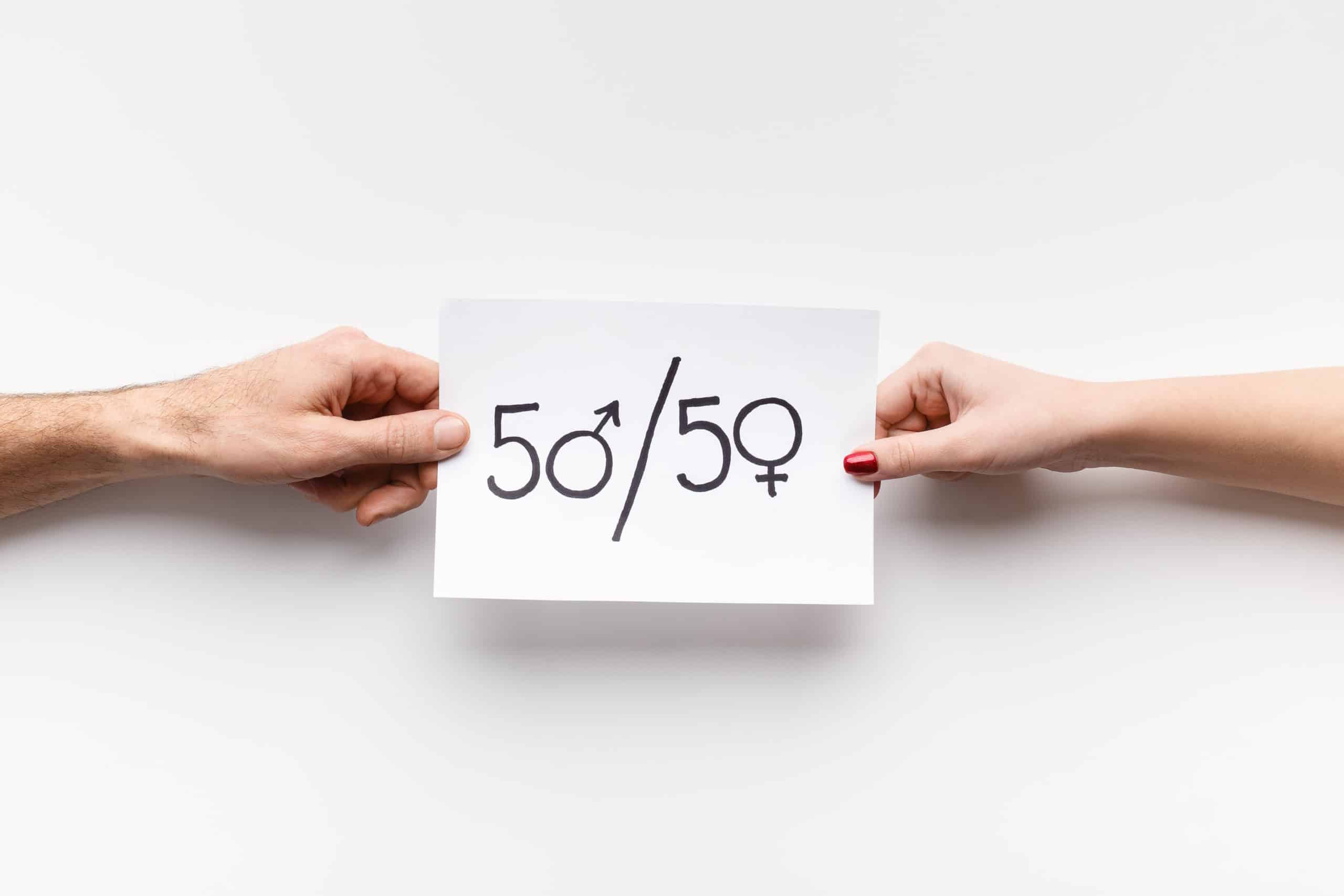
In recent years, significant efforts have been made to strengthen professional equality and gender diversity between men and women, with the aim of reducing situational gaps. While various laws suggest we are moving closer to parity, the reality is that we are still far from it. Indeed, legislation within companies is slow to be implemented and put into practice.
While the largest companies are lagging behind and struggling to adapt, SMEs and micro-enterprises, pioneers in social innovation, hold the leading role.
Are you a company looking to commit to reducing inequalities?
Here is the article you need to start working toward perfect parity right now.
Gender equality: where do we stand?
Salaries.
Today, the average monthly salary gap in the private sector for full-time positions is -18.6% for women. Indeed, while women earn an average salary of €1,943, their male colleagues in equivalent positions and workloads receive an average salary of €2,339.
Over a 43-year career, the cumulative impact of this gap amounts to no less than €204,336.
Yet, it has been demonstrated on numerous occasions that gender equality is a driver of economic performance for companies. Everyone should therefore benefit from it.
Gender diversity in career choices.
Half of the female population is concentrated in only 12 out of 87 existing job families.
For example, 98% of home care workers are women, and the same applies to housekeepers, assistants, and secretaries. Among nursing assistants, the percentage of women is approximately 90%.
Women are also overrepresented in low-paying jobs.
Career advancement opportunities.
Contradictorily, women pursue longer studies and are more highly qualified than men. At the master’s degree level, women account for no less than 60% compared to 40% for men.
Nevertheless, far fewer women access management positions, where they represent only 17%. For executive positions, they account for 42%.
Regarding women leading companies, their numbers have been increasing in recent years, but the gap persists:
15% of female leaders for companies with fewer than 250 employees and 9% for large companies.
Work-life balance.
Balancing family life and professional life is a challenge that concerns both men and women equally. Everyone wants to thrive in both areas and find their balance. On paper, this is the case. In reality, things are quite different.
When a child arrives, 1 in 2 mothers reduces or interrupts her professional activity for at least 1 month, compared to 1 in 9 fathers. The question of maternity and paternity leave conditions could be raised here. Many employees complain about not having enough time to devote to their family when a child is born. This additional time granted to fathers would also benefit women who have just given birth.
Moreover, half of all women believe that the arrival of a child has negatively impacted their professional life.
In other words, there is still today for working women a choice to be made between their personal life and their professional life.
To conclude on this topic, it is important to note that 82% of part-time jobs are held by women. This high percentage is largely explained by the fact that women alone shoulder 75% of domestic work time — essentially a second working day after finishing the first.
Workplace parity according to the law.
The main principles of equality that companies of all sizes are required to uphold:
- Principle of non-discrimination: this refers to differences in treatment based on gender, which are considered an offense and punishable by law.
- Equal pay: the same work or work of equal value must be compensated equally, regardless of the gender of the person performing it.
- Setting professional equality objectives: the terms of these objectives vary depending on the size of the company in question.
Specific obligations for SMEs and micro-enterprises.
Companies with fewer than 50 employees.
- Set objectives aimed at professional equality.
- Take concrete measures to achieve them.
For companies with 50 to 299 employees.
4 steps are necessary and recommended to achieve genuine equality within the company:
- Conduct a diagnostic assessment.
Detailed analysis and diagnostic of the situation of men and women within the company for each professional category regarding the following areas:
- Hiring
- Training
- Professional promotion
- Qualifications
- Classification
- Working conditions
- Occupational health and safety
- Effective compensation and the balance between professional activity and personal and family life.
- Implement an action strategy.
Based on the completed diagnostic, define a strategy that includes:
- A review of the previous year’s actions
- Progression objectives for the coming year
- Performance indicators to track and measure the achievement of these objectives.
- Actions implemented to achieve them, along with a timeline and projected budget.
- Negotiate an agreement.
Once these two steps are completed, it is necessary to engage in collective bargaining with union representatives to reach an agreement on professional equality or, at the very least, a unilateral action plan.
The agreement or action plan must cover at least 3 of the 9 areas cited in the 1st step. Equal pay must be included as a mandatory component.
Any company that fails to comply with this legal obligation is subject to a financial penalty of up to 1% of its total payroll.
- Monitor and promote the actions.
Companies must then monitor the implementation and effective completion of the actions outlined in the agreement, as well as produce a summary of the action plan. This summary includes the progression objectives and actions taken, accompanied by quantitative indicators to measure their impact.
Finally, they must promote these actions by making the summary visible within the company and communicating it to anyone who requests it. This summary must also be published and visible on the company’s website.
Calculating the professional equality index.
All companies with at least 50 employees are required each year to calculate and publish their gender equality index on their website before March 1st.
They must also communicate it to their Social and Economic Committee (CSE) as well as to the labor inspectorate.
This index is calculated based on 4 to 5 indicators, out of 100 points:
- The gender pay gap
- The number of female employees who received a raise upon returning from maternity leave
- The gap in promotion distribution (for companies with more than 250 employees)
- Gender parity among the 10 highest-paid employees.
- The gap in the distribution of individual pay raises
The minimum required score is 75 points. If the company’s index falls below 75, it must implement corrective measures to reach this threshold within 3 years. These measures must be defined within the context of the mandatory negotiation mentioned above.
In the event of failure to publish the index, failure to implement corrective measures, or ineffectiveness of said measures, a financial penalty of up to 1% of the company’s annual payroll may be applied.
Would you like to conduct your parity diagnostic, calculate your index, or implement the actions needed to reach the required score? Boost’RH offers these services and provides you with HR experts who support you throughout the process.