
However, it is the employer’s legal obligation to ensure the health and safety of their employees. The employer must ensure the highest level of safety and well-being (physical and mental) for all employees, regardless of their profession, prevent the harmful effects of their working conditions, and protect them against dangers related to their work.
In this article, we will look at how to implement effective prevention policies within your company and thereby achieve significant savings. As the saying goes, prevention is better than cure.
The Importance of Health and Safety at Work
Statistics on Workplace Accidents and Occupational Diseases
Every year, hundreds of thousands of workplace accidents are recorded and hundreds of deaths. In 2021, the latest available figures, more than 600,000 workplace accidents were reported and 700 deaths.
Certain sectors are more at risk than others, particularly construction, agriculture, transport and logistics, extractive industries, and woodworking.
Accidents can occur at the workplace but also during the commute between home and work.
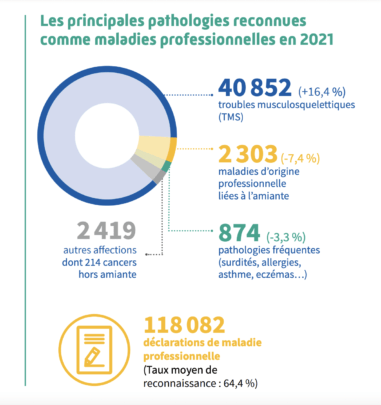
Regarding occupational diseases, the vast majority are related to musculoskeletal disorders (MSDs), as evidenced by this chart published in the annual health insurance report in November 2022.
Legal and Financial Implications for Companies
The Employer’s Civil and Criminal Liability
The employer’s liability in the context of occupational diseases or workplace accidents can take two distinct forms: civil liability and criminal liability.
Civil liability is invoked when the employer, through their failure to comply with Labor Code obligations, causes or contributes to the occurrence of an occupational disease or workplace accident. This results in an obligation to compensate in the form of damages, paid by the company or its civil liability insurance, in addition to the base compensation.
On the other hand, the employer’s criminal liability may be engaged when they violate a public order obligation of the Penal Code that could cause an occupational disease or workplace accident. Most often, the company director is held responsible. This stems from their obligation to ensure compliance with health and safety rules. However, they may delegate this responsibility to a specific committee, provided that this committee has the necessary authority to make decisions related to health and safety, has the appropriate equipment, and receives dedicated training.
The consequences of the employer’s criminal liability vary depending on the severity of the offense, ranging from a 2nd class fine to imprisonment accompanied by a fine of up to 75,000 euros. These penalties depend on the nature of the harm suffered, particularly the duration of work incapacity, as well as the degree of employer responsibility.
Significant Costs for the Employer
The overall cost of workplace accidents and occupational diseases is significant, often exceeding four to ten times the initial direct cost, or even more. These incidents generate a multitude of indirect costs that are difficult to quantify precisely. Beyond the suffering imposed on the injured worker and their family, which remains difficult to compensate, employers also incur significant financial losses.
For employers, direct costs include payment for work not performed, medical expenses and compensation, costs for replacing or repairing damaged equipment, reduction or temporary halt of production, increased training and administrative expenses, potential decrease in work quality, and a negative impact on the morale of other employees.
Indirect costs include replacing the injured or sick employee, training a new team member with the time needed for their adaptation, the delay before the new hire reaches the same productivity as the former employee, time spent on mandatory investigations, writing reports, and various formalities. Accidents often raise concerns among other workers, creating tension in employer-employee relationships. Furthermore, poor health and safety conditions can tarnish the company’s image.
Overall, the total cost of workplace accidents and occupational diseases is high for both workers and their families and for employers. At the national level, it is estimated that these costs can represent up to 3 to 4% of gross GDP, although the total cost remains difficult to determine due to the multitude of indirect costs that are hard to measure.
The Benefits of Prevention
Implementing preventive measures in the workplace generates numerous benefits, contributing significantly to the health and overall prosperity of the company.
Reduction of Accidents and Occupational Diseases
First and foremost, prevention results in a clear reduction of accidents and occupational diseases. By establishing safety protocols, providing adequate training, and raising employee awareness of potential risks, companies create a safer work environment, thereby limiting incidents harmful to worker health.
Savings on Direct and Indirect Costs
This reduction in accidents and occupational diseases has a direct impact on the company’s financial health through substantial savings on the direct and indirect costs of accidents and occupational diseases. By reducing the number of incidents, companies reduce expenditures related to medical care, compensation, replacement of damaged equipment, and training of new workers.
Indirect costs, such as time spent on investigations and administrative formalities, as well as improved labor relations, are also positively affected. According to figures from PIC magazine (Individual and Collective Prevention), for every 1 euro invested in prevention, the return on investment for the company is 2.70 euros.
Improved Productivity and Employee Engagement
Moreover, workplace prevention results in a notable improvement in productivity and employee engagement. By creating an environment where safety is a priority, employees feel valued and protected, which translates into greater motivation and increased commitment to their tasks. Workers who feel safe are more likely to actively participate in company initiatives and contribute positively to their professional environment. This increase in employee engagement has a direct impact on the company’s overall productivity, as engaged teams are more effective, creative, and resilient in the face of professional challenges.
Workplace prevention is not simply a regulatory imperative but a sound investment with multiple positive outcomes. It offers a threefold opportunity: reducing the risk of accidents and occupational diseases, achieving substantial savings on direct and indirect costs, and boosting productivity and employee engagement. By placing prevention at the heart of their strategy, companies foster a healthy, safe work environment conducive to long-term growth.
How to Implement Effective Prevention
Implementing effective prevention within a company relies on a methodical process that integrates thorough risk analysis, staff training and awareness, and a continuous improvement approach.
Risk Analysis and Assessment
First, risk analysis and assessment form the fundamental foundation of any prevention strategy, particularly through the implementation of a DUERP (Single Document for Occupational Risk Assessment). This involves the meticulous identification of potential hazards in every aspect of the company’s operations. Safety and personnel managers conduct detailed assessments, examining processes, equipment, and the work environment. By understanding the specific risks to which employees are exposed, the company can then develop targeted prevention plans, integrating appropriate safety measures to minimize these risks. This first step establishes the necessary foundation for a proactive and personalized approach to preventing accidents and occupational diseases.
Staff Training and Awareness
Staff training and awareness constitute the second cornerstone of successful prevention. Employees must be informed of the potential risks associated with their specific tasks and be equipped with the skills necessary to prevent them. Regular training sessions, covering topics such as safety procedures, proper use of equipment, and first aid, are essential. Awareness can also be reinforced through internal communication campaigns, displays in workspaces, and regular reminders. A well-informed and risk-aware workforce actively contributes to the safety culture within the company.
Furthermore, when properly trained, employees are more likely to recognize the early signs or symptoms of an occupational disease and thus act before a situation worsens.
Continuous Improvement
Finally, continuous improvement ensures the long-term sustainability of prevention practices. Companies must establish a system of periodic evaluation of their safety initiatives. This includes regular review of existing procedures in light of new data or operational changes, identification of new improvement opportunities, and constant adjustment of prevention policies based on feedback. Commitment to continuous improvement ensures that prevention remains adapted to changes in the work environment and new safety information.
To develop an effective health and safety program, all stakeholders must feel involved, regardless of their hierarchical level within the company. Employees must know the lines of responsibility and who is the designated health and safety officer. The role of the health and safety representative is essential for preventing problems that could arise.
The DUERP: A Key Prevention Tool
The DUERP (Single Document for Occupational Risk Assessment) is an essential tool for workplace safety management. This document aims to identify, assess, and prevent occupational risks to which employees may be exposed within a company.
The first function of the DUERP is to comprehensively inventory all potential risks present in the workplace. This encompasses risks related to professional activities, equipment used, substances handled, and the overall work environment. A thorough analysis is carried out to identify factors that could compromise worker safety and health.
The primary objective of the DUERP is to assess these risks by measuring their probability of occurrence and their severity. This assessment allows risks to be ranked according to their criticality, which helps establish priorities for intervention and implementation of preventive measures. This proactive approach aims to anticipate potential incidents and prevent them before they occur, thereby contributing to worker safety and well-being.
The DUERP also serves as a basis for defining and implementing prevention actions. By identifying the measures needed to reduce or eliminate the identified risks, the company can develop a concrete action plan. This may include adjustments to work methods, investments in new safety equipment, specific training for employees, or any other initiative aimed at minimizing identified risks.
In summary, the Single Document for Occupational Risk Assessment constitutes an essential pillar of the prevention approach within companies. It not only allows for a complete inventory of risks but above all assesses their relative importance and guides the implementation of appropriate preventive measures. By placing safety at the heart of professional activity management, the DUERP contributes to creating a safe and healthy work environment for all employees.
Do you need help developing your DUERP or updating it? Our health and safety experts can assist you: discover our DUERP offering.
Feedback and Case Studies
At Boost’RH, our health and safety expert consultants work within companies of all sizes and sectors, both in prevention and in response to accidents.
In response to an accident, our consultants implement a root cause analysis to understand how the accident occurred. Following this, an action plan is proposed to ensure such an accident cannot recur, and managerial safety visits are implemented to give workers on the ground a voice.
In prevention, the objective is to work by tracking two key indicators in order to reduce them:
- The frequency rate: proportion of workplace accidents;
- The severity rate: proportional to the duration of absence from work.
The method used is the MSV (Managerial Safety Visit). This methodology aims to give workers on the ground a voice.
For example, we intervened in a production workshop where female workers stood for 8 hours while maintaining production rates. A managerial visit was organized, and on this occasion, the workers were able to explain their issues: swollen legs, swollen ankles due to prolonged standing, causing MSDs and fatigue.
A meeting was then scheduled with the production and workshop directors and these workers. The methodology aims to restore dialogue between management and workers and thus involve workers in finding solutions. During the visit, the workers asked if it would be possible to install anti-fatigue mats. In the MSV method, action is taken directly if the cost is low, in order to observe results quickly. If the test is successful, the solution can be rolled out across all of the company’s production lines and sites.
In this case, installing the anti-fatigue mats improved the workers’ safety and health, but not only that. Productivity actually improved because, less fatigued, they were able to increase their pace! It is a virtuous cycle.
Generally, the measures taken are extremely pragmatic. By going out on the ground, in contact with workers, managers realize the conditions, and the approach helps restore dialogue with employees who want to feel heard and valued. The approach is all the more sustainable because, when employees themselves propose solutions, they are more inclined to apply them over the long term.
Conclusion
In conclusion, the importance of prevention in the context of health and safety at work is indisputable. Faced with the diversity of risks present in professional environments, implementing preventive measures proves crucial. From obvious accidents to more subtle dangers such as psychological or ergonomic factors, prevention aims to anticipate and avoid problems rather than resolve them after the fact.
It is imperative that elected representatives, unions, and employees play an active role in encouraging employers to eliminate hazards at the source, rather than forcing workers to adapt to dangerous conditions.
Management commitment and active worker participation are fundamental pillars of any effective health and safety initiative. Indeed, true prevention of accidents and diseases begins at the design stage of work methods. Thus, promoting a culture of prevention, integrated into all aspects of the professional environment, is essential for ensuring worker safety and well-being. By investing in prevention, companies not only preserve their employees’ health but also strengthen their productivity and reputation, thereby contributing to creating sustainable and ethical workplaces.