

Senior Index: Definition
The proposal for the Senior Index dates back to 2019. It was the Association Nationale des DRH (ANDRH) that put forward the idea of this index, along the same lines as the existing Professional Equality Index.
The government of Elisabeth Borne and Labour Minister Olivier Dussopt announced at the beginning of this year the upcoming implementation of the Senior Index publication, which will be mandatory from 2023 for companies with more than 1,000 employees.
The objective: to hold companies accountable regarding the hiring and retention of senior employees in order to address the low employment rate among 55-65 year-olds in France.
The Senior Index, based on several indicators yet to be defined, is expected to push companies toward greater transparency on the subject of senior employment, promote best practices, but also provides for financial penalties for poor performers.
Which indicators should be used for the Senior Index?
The Labour Minister has not detailed the indicators that will be used to implement this Senior Index. These indicators are expected to be defined following professional consultations; however, it has already met with some detractors, including the Medef, which opposes the principle of the index.
The Professional Equality Index taken as a model works with a 100-point indicator measuring compliance with gender equality in companies. To be transposed and applied to issues related to the age of workers, several indicators would need to be chosen, such as the internal professional mobility rate of employees over 55, the share of senior workers in recruitment (age is currently the leading cause of hiring discrimination), or their access to training.
For Benoit Serre, Vice-President of the ANDRH, this Senior Index would help shift mindsets around senior employment, by addressing both the recruitment of senior workers and the career development and dynamics of these populations.
Senior Index: pros and cons

While for the ANDRH and the government this index would help promote the retention and hiring of senior workers and their access to employment, not everyone shares this view.
Indeed, some opponents of the measure argue that by extending the retirement age, it is actually the duration of unemployment for seniors that will increase, not their career within companies. On this subject, the current figures are unequivocal: at age 60, 52% of people residing in France are still employed, of which 41.4% full-time. At age 62, this drops sharply to only 28.2% still in employment (according to figures from the Conseil d’Orientation des Retraites report of September 2022). It appears that the primary workforce adjustment variable for companies remains senior workers.
For others, it is not by imposing indexes or quotas that the problem of senior employment will be solved, as it is above all a matter of senior employability. Seniority (experience) is no longer considered an asset by companies but rather a burdensome financial cost.
The Medef fears that this Senior Index may generate overly heavy constraints that will weigh on companies.
{font-weight:700}{transition:.3s;align-self:flex-end;line-width:1em}{white-space:pre-wrap}
At age 62, only 28.2% of senior workers are still in employment.
What are the impacts for companies and how to successfully implement the Senior Index within your company?
Beyond the upcoming obligation to comply with the publication of this Senior Index, the real challenge lies in shifting mindsets within companies and HR departments.
The index alone will not solve the senior employment problem; concrete actions within companies will necessarily be required, in addition to public policies to that effect.
The role of HR in senior employability
Companies and HR departments must understand now that they will need to work with increasingly older employees in the years to come. Due to the extension of working life, today’s 57-58 year-old workers will be tomorrow’s 61-62 year-olds. To avoid merely postponing the problem, HR therefore has a role to play right now with future senior workers.
Indeed, age-related discrimination is the only form of discrimination that is not yet addressed within companies, even though it is the leading source of perceived discrimination among employees according to the Equal Opportunities Perception Barometer published in September 2022 by the MEDEF.
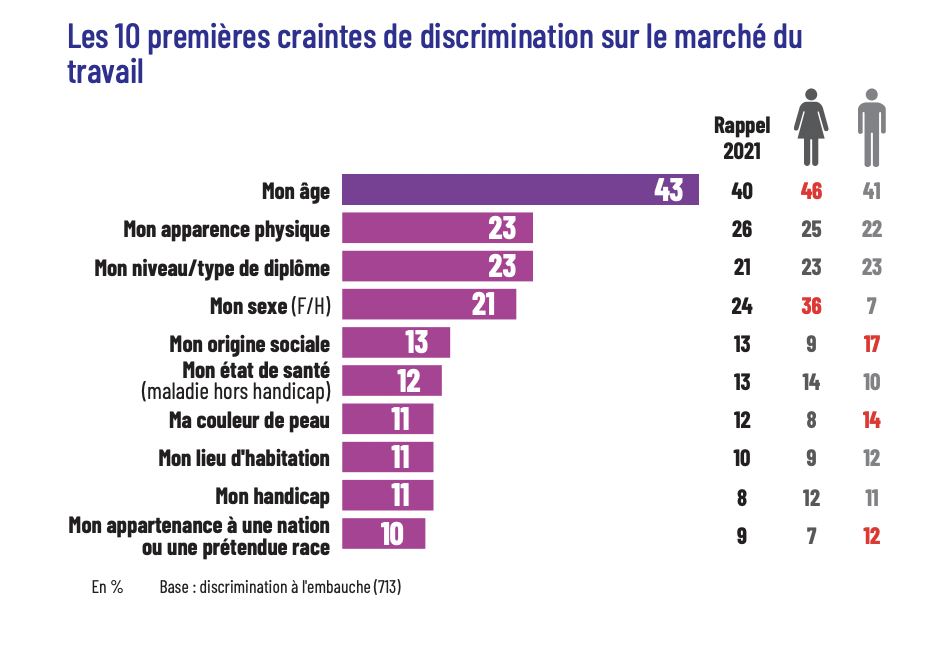
Companies, through HR, must therefore anticipate by taking specific measures targeting employees from the age of 50 onwards, to avoid reproducing the problem five years later. Strategic Workforce Planning (GPEC – Gestion Previsionnelle des Emplois et des Competences) must now include a “senior employment” component. While some companies have already begun implementing skills assessments, specific training plans, or offering Validation des Acquis de l’Experience (recognition of prior learning) to these populations, the commitment to senior employment is a challenge for the years ahead for companies and HR.
Age-related discrimination is the top concern for employees
Calculating the Senior Index: the central role of HR
In line with the Professional Equality Index, calculating the Senior Index will be HR’s responsibility. HR must therefore take ownership of the subject since they will be tasked with calculating it, explaining the score, and analyzing it to identify areas for improvement. Although the subject ultimately concerns the entire company, it is up to HR to be the driving force and to lead with proposals. If companies simply calculate the index without further action, there will be no impact. The necessary measures must be taken proactively. Indeed, with this index, the score can shift from one year to the next depending on retirements, so nothing is ever guaranteed. This is a genuine opportunity for HR to demonstrate their added value.
This index requires first conducting an audit of the company’s actions in favour of senior employment, and then implementing new specific measures to improve the score. The main areas for improvement include training (only one-third of employees over 50 continue to receive training) and end-of-career arrangements (adaptation of working hours, compensation).
For the implementation of the Senior Index, company HR departments could, for example, use the services of time-sharing HR Directors in order to free up time for these new topics or to delegate the implementation of the index.
To support you on a daily basis: https://www.boostrh.com/services-rh/politique-et-strategie-rh/
OUR EXPERTISE AT YOUR SERVICE
HOW TO CALCULATE YOUR COMPANY’S SENIOR INDEX?
EXPERT OPINION
Ariane – HR DIRECTOR AT BOOST’RH GROUPE
According to our expert, the Senior Index follows the same logic as the Professional Equality Index, hence the government’s use of the same terminology. The Professional Equality Index is quite demanding insofar as the law clearly defines what it must contain and how it must be calculated. This makes it very objective and readable. Building on this experience with the Professional Equality Index, the government must believe it is a proven method that drives change, hence its transposition for senior workers, our expert suggests.
If we continue the comparison between the two indexes, it is therefore likely that the calculation of the Senior Index will be demanding in order to ensure maximum objectivity and universality. Similarly, while it has been announced that it will be mandatory for companies with more than 300 employees, there is a strong chance that this will soon apply to companies with 50 or more employees.
Beyond the index, senior employment is part of the broader trend of integration, inclusion, and consideration of diversity. In recent times, companies have been finding it harder to recruit, and candidates and employees are increasingly scrutinising companies (image, CSR). The Senior Index is thus an opportunity that companies can seize in terms of employer branding and CSR. In conclusion, according to our expert, senior employment could also be part of the answer to the recruitment question and the difficulty of hiring. Companies could look for candidates among a population nearing the end of their career that they currently tend to exclude from potential applicants.
Learn more
.rtl.e-con-inner>,.e-con>
Summary
In 3 Questions
1
What is the Senior Index?
The Senior Index is an index that measures the employment and hiring rate of senior workers (those over 55) within companies. Its objective is to improve the retention of senior workers in employment in light of the extension of working life. The index must be published by companies with more than 300 employees, and non-compliance may result in financial penalties.
2
What are the indicators of the Senior Index?
The calculation indicators for the Senior Index have not yet been defined as of early 2023. They will need to be established following professional consultations. The indicators discussed so far include: training rate, hiring rate, and professional mobility rate of senior workers.
3
What is the role of human resources in implementing the Senior Index?
Human resources will need to work with an older workforce in the coming years. HR must therefore take these developments into account now in career and employment management. The HR strategy of companies will need to evolve to improve senior employability: retention in employment and hiring.