

What is a headhunter?
A headhunter is a recruitment specialist who actively searches for highly qualified candidates for key positions, often using advanced sourcing methods and professional networks, to meet the specific needs of companies.
Unlike traditional recruiters, headhunters are mandated to find specific talent. These individuals are often currently employed and not actively job hunting.
A headhunter may be part of an external recruitment firm, a consulting firm specializing in recruitment advisory, or work as a freelancer.
Role and responsibilities of a headhunter
The headhunter is involved in the entire recruitment chain, from identifying the company’s needs to integrating the selected candidate within the organization.
Identifying company needs
Before beginning the candidate search, the headhunter must thoroughly understand the client company’s needs, including the company culture, job requirements, and necessary skills.
Candidate search
Using various tools and techniques, headhunters identify potential candidates, often those who are not actively seeking new employment. They use databases, professional networks, and platforms such as LinkedIn to find suitable talent.
Evaluation and selection
Once potential candidates have been identified, the headhunter conducts a thorough evaluation of their skills and suitability for the position. This includes interviews, skills assessments, and reference checks.
Presenting candidates to the company
After selection, the headhunter presents a shortlist of candidates to the client company, facilitating interviews and offering advice on the final choice.
Negotiation and onboarding
The headhunter also assists their client in negotiation (salary, conditions), ensuring that both parties’ expectations are aligned and that the candidate’s onboarding goes smoothly.
Difference between a headhunter and a traditional recruiter
Although the terms “headhunter” and “recruiter” are often used interchangeably, there are notable differences between these two roles:
- Scope of work: recruiters often work on a high volume of positions to fill, while headhunters focus on specific, often senior-level recruitment.
- Search methods: recruiters primarily use job postings and active candidate databases, whereas headhunters focus on proactively sourcing “passive” talent.
- Client relationship: headhunters generally establish closer relationships with their clients, often acting as strategic advisors.
Why do companies use headhunters?
Need to find specific or rare talent
Companies generally engage headhunters because they lack an internal department, or because they struggle to recruit strong profiles through traditional means.
Headhunters are particularly useful for recruiting highly sought-after profiles in certain sectors such as IT, or highly qualified professionals with rare skills and high compensation packages (over 100,000 euros/year).
Some companies nevertheless choose a mixed approach: they publish job postings while engaging a headhunter in parallel.
Confidentiality and discretion in the recruitment process
Discretion and confidentiality are part of the headhunting profession’s code of ethics. Throughout the process, the headhunter never reveals the name of the company they are recruiting for. The company name is disclosed only if the company wishes to meet the candidate after the headhunter has completed the shortlisting.
The headhunter never publishes job postings; they contact candidates through direct approach (executive search) to ensure total discretion.
Time savings and efficiency
The headhunter is permanently searching for talent. Often specialized in one or more industry sectors, the headhunter conducts constant market intelligence on the job market. Thus, when a company engages them for a recruitment assignment, they save valuable time since they know where to find the right candidates in the shortest timeframe.
Access to a network of passive and highly qualified candidates
The headhunter continuously builds a pool of passive and highly qualified candidates. They maintain their network through excellent interpersonal skills and by leveraging professional networks such as LinkedIn.
What are a headhunter’s methods?
Proactive search and use of professional networks
Proactive search is at the heart of a headhunter’s activities. Unlike traditional recruiters who may simply post advertisements and wait for applications, headhunters actively seek talent wherever they are. Professional networks, such as LinkedIn, play an important role in this approach. These platforms allow headhunters to identify and directly contact qualified professionals, even those who are not actively job searching. LinkedIn integrates artificial intelligence into its search model to improve recruitment precision and efficiency. AI helps the headhunter identify the best candidates by analyzing billions of data points and continuously learning from previous interactions. Click here to discover how AI is revolutionizing HR. Attending networking events, conferences, and professional groups, both online and in-person, is also an effective way to establish contacts and identify potential candidates.
Advanced sourcing techniques and internal databases
Headhunters source on job boards and use various other channels: social networks (particularly LinkedIn), alumni directories, resume databases, as well as conferences and professional trade shows.
They use advanced sourcing techniques such as specific keywords, filters, and Boolean searches to refine results on recruitment platforms and professional social networks.
Additionally, headhunters often have internal databases containing detailed information on candidates they have met over the years. These databases are valuable tools for quickly identifying qualified candidates matching their clients’ search criteria. Applicant tracking systems (ATS) and customer relationship management (CRM) systems also enable effective tracking of candidate interactions and maintaining up-to-date records.
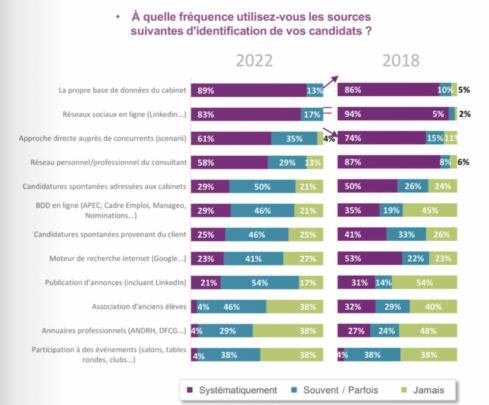
Study conducted by Oasys consultants among executive search and recruitment firms in April 2022
Direct approach and preliminary interview
Once potential candidates have been identified, headhunters adopt a direct approach to contact them. This approach requires strong communication and negotiation skills, as it often involves convincing professionals who are already employed to consider a new opportunity. The preliminary interview is a key step where the headhunter quickly assesses whether the candidate possesses the basic qualifications and is potentially interested in the position. These interviews are generally conducted by phone or video call before a possible in-person meeting with the candidate.
In-depth assessment of skills and cultural fit
Beyond technical qualifications, it is essential to ensure that the candidate integrates well into the client company’s culture. This involves detailed interviews, specific skills tests, and reference checks. The headhunter must understand the values and dynamics of the client company to assess whether the candidate will integrate well and contribute positively to the organization. This thorough assessment ensures that the candidates presented to clients are not only qualified but also perfectly suited to the work environment.
How to get noticed by headhunters?
Here are some simple tips if you want to get noticed by headhunters:
Optimize your LinkedIn profile and other professional networks
As we have seen, LinkedIn is a preferred prospecting channel for headhunters.
To get noticed, a polished LinkedIn profile is therefore essential. Be sure to include the most relevant keywords for your profile, particularly in job titles, and also specify your industry sector. Finally, a professional profile photo is mandatory.

Participate in industry events and networks
Participating in professional events in your sector will help you be identified as an industry expert and improve your visibility among recruiters, including headhunters. They themselves attend these events for sourcing purposes, so you need to be present to be visible to them.
Build a strong professional network
Maintaining your network is essential, especially in a world of work that increasingly relies on recommendations and referrals. Maintain good relationships with all your managers and colleagues: they are a preferred point of contact for headhunters. A headhunter will systematically ask you for references to contact (former managers, peers, or direct reports) as part of the recruitment process, so it is essential to continue maintaining your professional network and to leave on good terms when departing a company.
Headhunter salary
Headhunter salaries can vary considerably depending on experience, specialization, and geographic region.
Salary ranges
In France, the average headhunter salary ranges between 50,000 and 80,000 euros gross per year. However, experienced headhunters or those specialized in high-demand sectors can earn significantly more.
- 0 to 2 years: between 25,000 and 40,000 euros
- 2 to 5 years: between 40,000 and 60,000 euros
- 5 to 10 years: between 60,000 and 90,000 euros
- 10 to 15 years: between 90,000 and 120,000 euros
- Over 15 years: between 120,000 and 150,000 euros and above
Salary ranges by headhunter experience level (source: studyrama)
Bonuses and commissions based on successful placements
In addition to the base salary, many headhunters receive commissions or bonuses based on successful placements that can reach up to 20% of their gross annual salary.
Career prospects
Headhunters can progress to management roles, establish their own recruitment firm, or specialize in niche sectors to increase their income and influence.
Conclusion
By serving as intermediaries between company needs and candidates, headhunters play a major role in the HR landscape. Their ability to identify and attract top talent enables companies to find the leaders and experts needed to remain competitive and innovative. In an increasingly competitive labor market, the proactive search for qualified candidates and the direct approach adopted by headhunters provide access to a talent pool often beyond the reach of traditional recruitment methods, also enabling companies to save time and improve efficiency.
For candidates, headhunters offer unique opportunities often inaccessible through conventional channels. Thanks to their extensive network and deep understanding of company needs, headhunters can connect professionals with positions that perfectly match their skills and aspirations. They also play an advisory role, guiding candidates throughout the recruitment process and helping them navigate salary negotiations and working conditions.
For those interested in a career in recruitment, becoming a headhunter can be an exciting and rewarding path. This profession not only offers the opportunity to develop specialized skills in sourcing and talent assessment but also to have a direct impact on companies’ success and individuals’ careers. With attractive compensation, varied career prospects, and the satisfaction of contributing to organizational growth and career development, the headhunting profession is a career option worth exploring.