

What is Onboarding?
Onboarding, or corporate integration, is a structured process that enables a new employee to adapt to their role, the company culture, and their colleagues, while learning the tools and work practices.
Onboarding has several key objectives:
- Cultural immersion: introducing new hires to the company’s culture, values, and practices. This helps them better understand their environment.
- Reducing turnover: effective onboarding improves employee satisfaction from the start, thereby reducing the risk of premature departures.
- Increasing productivity: by effectively integrating new employees, they become operational more quickly, which improves the company’s overall performance.
Unlike a simple administrative onboarding, which is limited to managing contractual documents and logistical setup, onboarding is a more comprehensive process. It includes not only administrative aspects, but also the support and guidance needed for the new employee to succeed in the long term.
Effective onboarding includes, for example:
- An introduction to the teams and offices, for instance during a welcome breakfast
- A welcome kit ready with everything needed for the workstation (computer, badge, notebook) and branded merchandise
- A presentation of internal tools and processes
- Training sessions on key tasks
- One-to-one meetings with different team members and managers
- Regular check-ins with the manager and HR to ensure the employee’s successful integration
- A newcomer feedback report at the end of the onboarding period
Why is Onboarding Crucial for Businesses?
Onboarding is a critical phase for companies because the integration period strongly influences the satisfaction and performance of new employees. In fact, 45% of resignations occur within the first year of the contract (INSEE 2020). This phase is therefore decisive for the rest of the employee’s tenure within the company.
Impact on Productivity
A well-structured onboarding process allows new employees to become productive more quickly. Tasks and objectives are clear from the outset, and the employee knows where to find the resources needed to perform their work effectively. According to a study by the Society for Human Resource Management (SHRM), effective onboarding increases new hire productivity by 50% during their first year.
Engagement and Retention
Onboarding is directly linked to employee engagement and loyalty to the company. A well-integrated employee will feel more engaged in their work and will be less likely to leave the company. Studies show that 69% of employees stay with a company for more than three years if they had a positive onboarding experience.
Company Culture
Effective onboarding helps convey the company’s values and culture. This helps new employees quickly align with the company’s mission, thereby facilitating their immersion. Company culture then becomes a central pillar of their engagement.
Successful Onboarding Statistics
The figures speak for themselves: companies with a structured onboarding process experience an 82% higher employee retention rate and a 70% increase in new hire productivity. Conversely, 20% of new employees leave their position within the first 45 days if the integration process is poorly managed. Finally, the cost of a failed onboarding is estimated at an average of 7,000 euros for the company (Parlons RH).
The Stages of an Effective Onboarding Process
An effective onboarding process is generally divided into several stages and lasts up to 9 months. Each of these stages contributes to a progressive and well-structured integration.
Preparation Before the New Employee’s Arrival
Even before the new employee arrives, it is essential to prepare for their arrival. In fact, one in five candidates does not even show up on the first day. It is therefore essential to maintain contact with the recruited candidate until the integration day. For example, you can share the team organizational chart in advance, schedule their first introductory meetings in their calendar, and of course prepare all their equipment (computer, phone, workstation, etc.).
First Day: Welcome and Introduction
The first day is crucial. The goal is to ensure that the new employee feels welcomed and comfortable. Here is what is recommended:
- Organize an office tour.
- Introduce team members and key stakeholders.
- Provide a welcome kit including company information and branded merchandise.
- Set aside time as a manager to be available for the newcomer throughout the day.
First Week: Objectives and Initial Training
During the first week, it is important to clearly define the new employee’s objectives. Initial training on the tools they will use daily and on internal processes must also be provided. The manager should help the employee take ownership of their responsibilities and understand how their work fits into the company’s strategy.
First Month: Follow-up and Feedback
During the first month, regular follow-up must be in place to ensure the employee is progressing well in their role. Regular meetings with the manager are essential for gathering feedback, making adjustments if necessary, and strengthening integration within the team and the company. A newcomer feedback report at the one-month mark is often useful at this stage, both to verify that the employee feels comfortable within the company and to adjust the onboarding process based on the new employee’s feedback.
Long-term Follow-up (90 Days and Beyond)
Effective onboarding does not end after the first month. Follow-up should be conducted at 90 days and beyond to ensure lasting integration. At this stage, it is essential to set long-term objectives and evaluate the employee’s progress in their new role.
Tools and Technologies to Facilitate Onboarding
Numerous technologies help optimize the onboarding process, making integration smoother and more interactive.
Onboarding Management Software
Today, most HRIS solutions include an onboarding module. Software such as Workelo, Lucca, Factorial or Heyteam enable you to:
- centralize information;
- automate administrative tasks in the onboarding process;
- create personalized journeys based on the newcomer’s role;
- delegate certain onboarding tasks to managers, colleagues, and peers from other departments;
- involve and coordinate all stakeholders through a single interface.
These software solutions centralize information and ensure effective tracking of the various stages. They typically integrate with communication tools such as Slack or Microsoft Teams
.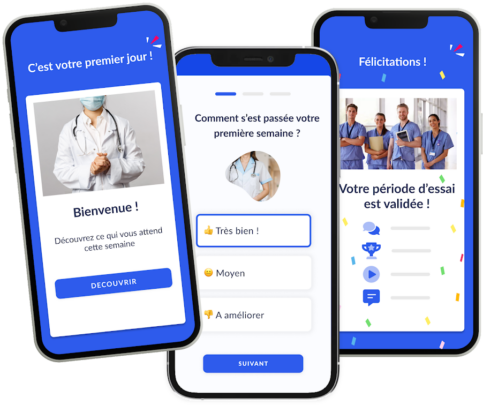
Workelo onboarding visuals
Other Onboarding Tools
Beyond onboarding software, companies can also provide newcomers with welcome videos, intranet portals, and e-learning platforms to deliver resources tailored to their role. These tools help accelerate learning and ensure progressive skill development.
Common Mistakes to Avoid in Onboarding
Although onboarding is an essential process, it is easy to fall into certain pitfalls. Here are the most common mistakes to avoid.
- Lack of preparation: failing to anticipate the arrival of a new employee is a frequent mistake. It is crucial that everything is ready before their arrival, whether it be equipment or necessary information. There is nothing worse for a new employee than arriving at a new company and not having a workstation or equipment already prepared.
- Unclear expectations: an effective onboarding process requires defining clear objectives from the outset. Without a precise vision of expectations, the employee may feel lost or demotivated.
- An overly administrative process: focusing solely on administrative aspects without considering the human element is another mistake. Onboarding should include a social component and attention to team integration.
- Neglecting follow-up: insufficient or nonexistent follow-up after the first month can undo the entire integration process. It is essential to maintain regular support to ensure successful long-term integration.
Practical Tips for Successful Onboarding

To ensure successful onboarding, here are some practical tips.
Personalize the Onboarding
Every employee is unique. It is important to adapt the process based on the role, seniority level, and the company’s specific expectations for the new team member.
Ideally, clear objectives should be defined from the first day, in agreement with the newcomer. This allows them to actively participate in their own integration.
Create an Integration Checklist
A clear checklist of tasks to complete ensures nothing is overlooked, from initial training to the 90-day follow-up. It also helps define the roles of each stakeholder (HR, managers, team members) in the integration process.
Establish a Mentorship System
A mentor can support the new employee throughout their integration. They can be an employee from another department or a team member. The mentor will, for example, be responsible for organizing the welcome breakfast or lunch, giving a tour of the offices to introduce the workspace to the newcomer, and serving as a point of contact for any practical questions unrelated to their role.
Conclusion
Onboarding plays a crucial role in a company’s success. A well-designed process not only reduces turnover but also improves engagement, productivity, and satisfaction among new employees. By providing personalized integration, supported by appropriate tools and regular follow-up, companies can maximize the chances of long-term success for their team members.
To optimize this essential process, it is possible to engage a time-sharing HR expert or HR Director. These professionals can help you structure and personalize your onboarding, ensuring a smooth and effective integration of each new hire into your organization.