

Definition and importance of a job description
A job description is a document that provides a detailed outline of the functions, responsibilities, skills, and qualifications required for a specific position within an organization. It is an essential HR tool that serves as an official reference for potential candidates and current employees, clearly defining the company’s expectations for a given role.
For the company, a well-written job description facilitates the recruitment process by attracting qualified candidates for the position in question. It also contributes to better internal organization by clarifying each person’s roles and responsibilities, which helps improve productivity and efficiency.
For employees, the job description provides a clear understanding of what is expected of them in their role, which can increase their job satisfaction and engagement. It also serves as a basis for performance evaluations and career development.
A poorly written job description can lead to misunderstandings and unrealistic expectations for both the company and employees. This can result in poor hiring decisions, job dissatisfaction, and ultimately a higher turnover rate. Furthermore, it can generate internal conflicts and decreased productivity due to poor distribution of tasks and responsibilities.
Essential elements of a job description
For a job description to be effective, it must contain the following elements:
-
Job title: the job title must be clear and accurately reflect the function. It must be specific enough to attract the ideal candidate profile. The title is the element that is seen first and searched for by candidates on search engines — do not neglect it!
-
Department and hierarchy: this involves indicating the department to which the position is attached and the hierarchical position. This helps situate the role within the overall organization of the company.
-
- Purpose of the role: this section should provide an overview of the objective and challenges of the position and its contribution to the organization.
- Missions, responsibilities, and tasks: the main missions as well as the specific responsibilities and tasks of the role must be detailed. This should include both daily activities and more strategic responsibilities.
-
Required skills (technical and interpersonal): this involves listing the technical skills necessary for the position, as well as the interpersonal skills or soft skills that will be essential for success in this role.
-
Qualifications and required experience: it is essential to indicate the required academic and professional qualifications, as well as the necessary professional experience. This may include degrees, certifications, and years of experience in similar roles.
-
- Stakeholders: this specifies the main interactions within the scope of the function. Stakeholders can be internal and external to the company (suppliers, clients, service providers…).
-
Working conditions: to stand out from the competition, it is important to provide details about working conditions such as schedules, workplace location, equipment provided, and any specific conditions such as travel requirements.
-
Career development and advancement opportunities: indicating advancement and career development possibilities associated with the position helps attract ambitious and motivated candidate profiles.
Steps to writing an effective job description
To write an effective job description, several steps should be followed.
Gathering preliminary information
To begin, all necessary information about the expected profile for the position and the role itself must be gathered. To do this, speaking with current employees in similar roles and with line managers provides maximum information directly from the field and enables the subsequent drafting of a relevant job description.
If several employees hold similar positions covered by the same job description, it is useful to pool their experiences to enrich the description.
Collaboration with line managers and HR
Once the information has been gathered, the job description should ideally be co-created with line managers and HR teams. This ensures that all relevant information about the position is included while meeting HR objectives for recruitment, internal mobility, and more.
Writing
The job description should be written in a clear, concise manner that is understandable to a candidate external to the organization. Internal jargon or acronyms should therefore be avoided.
Using short sentences is recommended to facilitate reading. Anyone reading the job description should be able to understand it quickly. Readability should be prioritized over exhaustiveness.
To describe tasks and missions, action verbs should be used. This makes the job description more dynamic and precise. For example, instead of writing “responsible for management,” prefer “manage and supervise.”
Review and validation
Having the document reviewed and validated by line managers and HR ensures that it accurately reflects the expectations and profile for the position.
Practical job description example
To ensure you don’t miss anything, Boost’RH offers you a job description example that can serve as a template to attract the ideal candidate.
- TARGET ROLE DEFINITION
|
Role: Head of Accounting
Reports to: Director
|
|
Updated by: XX
Date: // |
Validated by: XX
Date: // |
| PURPOSE OF THE ROLE
Describe the essential objective of the position, the expected outcome |
|
Oversight of all accounting activities of the Mutual Insurance Company and preparation of the annual Balance Sheet.
Control of benefit payments or contributions of the Mutual Insurance Company. Ancillary activities in personnel management, equipment or service procurement Management of the assistant |
| MAIN MISSIONS
Describe the main tasks and responsibilities to meet the organization’s needs |
General accounting:
Cost accounting:
Treasury:
Annual balance sheet
Service procurement
Property management
Personnel management
|
| CROSS-FUNCTIONAL MISSIONS
Describe the functions or areas of intervention as a replacement or in support of a colleague |
|
Partial replacement by the Accounting Assistant internally; externally, the statutory auditor could cover their absence.
Able to partially replace:
|
| STAKEHOLDERS
Specify the main relationships of the employee within the scope of their function |
|
| Internal
Entire team and the Board |
External
Statutory Auditor Lawyer Property managers Suppliers Bankers Members |
| RESOURCES PROVIDED | |
| Human
One Accounting Assistant |
Equipment
Desktop computer with office suite Accounting software Mutual insurance software |
| APPENDIX
Role definitions |
|
Member and prospect relations:
Contract and membership management:
Contribution management:
Benefits management:
Third-party management:
Support functions:
|
Tips and best practices for optimizing a job description
To make your job description truly effective, here are some best practices to maximize its impact and clarity.
Use inclusive language
Using inclusive language helps attract a wide range of candidates and promote diversity within the company. This involves writing gender-neutral sentences, avoiding stereotypical phrasing, and including expressions that demonstrate the company’s openness to all profiles. For example, replace “he must” with “the person will” and ensure that all skills are valued equally, without assuming the candidate’s gender.
Highlight company values
Company values should be integrated into the job description so that candidates can envision themselves within the company culture. This helps attract individuals whose values align with those of the organization. For example, if the company values innovation and teamwork, it is wise to mention this in the job description, explaining how these values are reflected in daily work life.
Adopt an attractive and readable format
The job description format should be both attractive and easy to read. To achieve this, use clear headings and subheadings, bullet points for required skills and main missions, and short paragraphs. A simple yet effective design helps maintain the reader’s attention and convey essential information quickly.
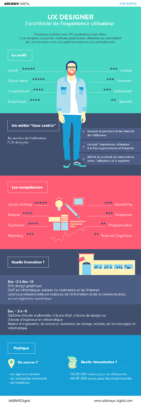
Example of an attractive job description in infographic format.
Credit: Abilways-Digital
Regularly update job descriptions
It is imperative to regularly update job descriptions to ensure they always reflect the current needs of the company. Job descriptions must evolve with changes in the organization, technologies, or market expectations. An up-to-date description also shows that the company is dynamic and in tune with its environment.
Software and tools examples for assistance
Several tools can facilitate the writing and optimization of job descriptions. Platforms such as Textio offer suggestions for inclusive and attractive language, while JobDescription.ai helps generate job descriptions based on predefined templates. HR management tools such as Workday or BambooHR also integrate features for creating and updating job descriptions, enabling centralization and automation of this process.
You can also get support in writing your job descriptions from an outsourced HR professional who will bring their experience to help you write effective job descriptions or update your existing ones.
Summary
In summary, a well-written job description is essential for attracting the right candidates and ensuring effective skills management within the company. By adopting simple and inclusive language, highlighting company values, and opting for a clear and readable format, you maximize the effectiveness of your job descriptions. Remember to update them regularly so they always reflect your organization’s current needs. By applying these best practices, you will not only improve your recruitment processes but also the satisfaction and engagement of your employees.