
Which Companies Are Affected?
Impacted Areas: Paris and Other OPG Venues
Paris and nearby cities host most of the events for these Games, and attendance will be significant with approximately 10 million visitors expected. Companies whose workplaces are located near event venues will therefore be particularly impacted, making access to the workplace difficult for employees, due to both security and crowd-related issues.
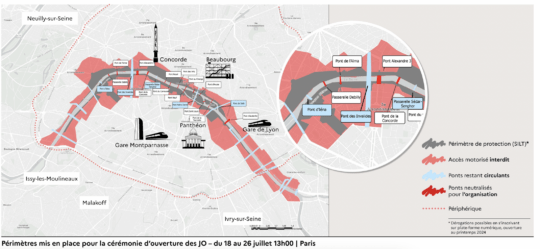
Indeed, access to certain areas is restricted for security reasons, with different levels depending on the perimeter (gray or red), and a pass will be required for entry (see the Ministry of the Interior map below). The police prefecture has published online the list of exemptions and authorized persons allowed to travel within security perimeters. You can check whether you are eligible for an exemption for your employees and anticipate requests, as pass issuance is not automatic or immediate.
Additionally, several metro stations will be closed, making travel more challenging, not to mention the crowds in public transport before and after events.
To anticipate travel and the difficulties your employees may encounter, the Ministry of Transport has published an interactive map of travel impacts in the Ile-de-France region with security perimeters and public transport crowd forecasts.
Which Companies Are Affected?
Companies impacted by the OPG fall into two categories:
- companies whose workplaces are located within the security perimeters or near Olympic event venues.
- companies that will experience activity peaks due to the OPG: food service, transportation, security, broadcasting, etc.
We will explore later in this article how to adapt your organization based on your situation.
What Are the Impacts on Companies Located Outside the Main Olympic Zones?
While the impact will be lesser for companies located outside the main OPG zones, it is not negligible either. Indeed, due to heavy crowds in public transport, some employees may still encounter difficulties getting to their workplace, particularly if they need to travel through areas affected by the OPG.
The psychological impact on employees should not be overlooked either. Indeed, the uncertainty related to travel and security can also generate stress for your employees. Preventive measures should therefore be anticipated.
Analyzing Your Company’s Specific Needs
Assessment of Impacted Activities and Teams
While these events will be a source of opportunities for some companies, they will nevertheless impact their organization. Indeed, it will be important to show flexibility in activity planning. As an employer, you must be ready to review work organization during this period to ensure business continuity or respond to activity peaks generated by the OPG.
On this topic, the Ministry of Labor has detailed the various work arrangement provisions available during the Olympic and Paralympic Games. Remote work, use of leave, exemptions from weekly rest—these provisions are outlined in the labor code and can be implemented within your company based on your situation.
Identifying Critical Periods and Priority Tasks
Depending on your company’s situation, you may need to adjust working hours, work locations, or review the priorities and deadlines of ongoing projects.
To help you implement the provisions outlined in the labor code and identify critical periods and priority tasks, you can seek support from time-sharing HR Directors. They master the subtleties of the labor code and can quickly implement the necessary arrangements thanks to their experience and expertise.
Strategies for Work Organization
Flexible Working Hours
During this period, modifying working hours is possible. Employers can, for example, offer their employees staggered hours to avoid peak times in public transport. You can thus propose starting earlier or delaying end-of-shift times. For these situations, consultation with the works council (CSE) or union representatives must be organized.
Furthermore, working hours can also be modified during this period. This is governed by the “OG 2024” law, in the municipalities hosting competition venues as well as neighboring or nearby municipalities. Thus, some companies may, for example, temporarily waive Sunday rest to maintain essential activities for the smooth running of the Olympic Games. The applicable provisions and affected activities are specified in the decree of November 23, 2023.
Of course, nothing can be imposed on the employee; they must volunteer to work on Sundays and receive compensation (at least double pay and compensatory rest).
The same applies to weekly rest, daily rest, and maximum working hours.

Remote Work and Digital Solutions
During this period, for companies that can use it, remote work is strongly encouraged. Since the COVID-19 pandemic, many companies have established collective agreements or charters on remote work and are fully prepared. In the absence of these provisions, the employer can still implement remote work to adapt to circumstances. To this end, the Ministry of Transport has published an article for employers and employees to encourage remote work when possible, outlining the conditions (employer rights and obligations for remote work).
Remote work can reduce public transport ridership during peak hours by 18 to 20%.
Moreover, the Ile-de-France job market is particularly compatible with remote work: over 60% of employees work in the market services sector (Sources: Ministry of Transport – INSEE).
Team Rotation and Attendance Management
The Ministry of Labor also recommends prioritizing the use of paid leave and/or rest days (RTT) during this period, or even closing the company. It is quite common for companies to carry out annual closures in August; this year, these companies could align the annual closure with the Games period.
While the employer can require employees to take leave, this must be done in consultation with representative bodies such as the works council (CSE). In companies where RTT days are applied, employers can also require the use of rest days from the employer’s quota.
Effective Internal Communication
During this period, it is imperative to strengthen internal communication, for several reasons:
- ensuring coordination between employees and teams, particularly in cases of widespread or larger-than-usual remote work;
- informing employees of potential changes or adjustments;
- ensuring smooth project continuity;
- checking in with employees on how they are experiencing the situation.
This reinforcement may involve organizing more frequent meetings, setting up dedicated communication channels, or designating one or more contact persons to ensure the transmission of key information.
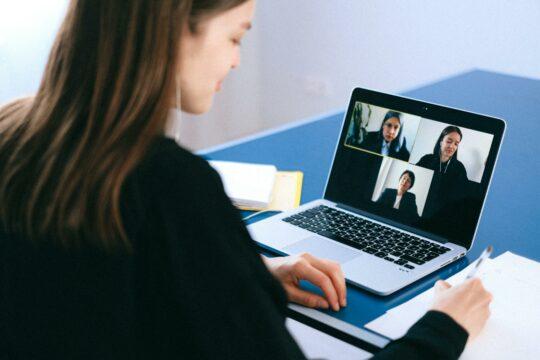
The use of online collaboration tools makes it easier to work remotely and manage staggered working hours where applicable. Tools such as Slack, Microsoft Teams, or Zoom enable teams to stay connected and collaborate in real time, even when working remotely.
Workplace Adjustments and Logistical Solutions
Optimizing Home-to-Work Commutes
Not all companies will be able to adjust their employees’ schedules or make extensive use of remote work. However, other solutions are available to them to make life easier for employees during this period.
Companies can encourage mutual support among colleagues by promoting carpooling, for example. They can also offer alternative modes of transport by subsidizing the purchase or rental of an electric bicycle during the period.
Maintaining Productivity and Employee Well-Being
This Olympic Games period generates stress for many employees. Indeed, the situation is unprecedented, there are many unknowns, and much office gossip circulating that fuels this stress (needing a QR code to cross certain zones, apprehension about transport and/or crowds, more complicated family arrangements, etc.).
For these reasons, the employer must absolutely ensure the mental health and well-being of employees during this period, to maintain a work environment conducive to their fulfillment and ensure their engagement and productivity despite potential difficulties.
For example, it is possible to set up meditation sessions to allow them to recharge during the day or to have a dedicated listening support service, led by the HR department or with a dedicated external provider during the Olympic period, such as an outsourced HR professional.
Finally, why not relocate your offices for a few days during this period by offering your employees a retreat seminar in the countryside? It is an opportunity to offer them a breath of fresh air and to generate new ideas to move projects forward, while strengthening team bonds.

Conclusion
If you have not yet considered work organization within your company for the Paris 2024 Olympic Games period, there is still time to take charge!
To ensure the continuity of your activities, Boost’RH offers time-sharing HR Directors and HR professionals who can intervene quickly to support you in implementing solutions in compliance with the labor code: schedule adjustments, working hour changes, rest days, remote work, and more. Drawing on their experience, they will quickly identify the essential measures to take so that the Paris Olympic Games remain an opportunity for everyone.