Application 1: Recruitment and Selection
Using AI to screen resumes and select candidates
Artificial intelligence (AI) is revolutionizing the recruitment process by automating numerous tasks.
First, AI tools enable the drafting of job descriptions and the distribution of job postings on relevant platforms.
Then, applicant tracking systems (ATS) using AI filter resumes to identify the most qualified candidates and automate initial communications.
Predictive analytics tools assess candidates’ skills and aptitudes, predict their suitability for the position and even their likelihood of success within the company. Sophisticated matching systems compare candidate profiles with those of high-performing employees to identify the best matches. This considerably reduces the time and effort required to shortlist suitable candidates.
Other tools enable initial video interviews to assess candidates’ linguistic and non-verbal skills and communicate the next steps in the recruitment process.
Examples of tools and technologies
There is no shortage of tools and platforms in the sector. Dozens of companies have emerged offering AI-based tools.
- For sourcing, we can mention among others Manatal, CVVIZ, Hireez
- For initial video interviews and candidate conversations: HireVue, Pymetrics
- For ATS that integrate AI features: Greenhouse, Lever, or even SmartRecruiters
Most tools combine multiple features, in several languages, and can therefore be used at every stage of recruitment. Moreover, these tools generally integrate with existing ATS systems. The choice of tools to implement will therefore depend on your needs and your current technology stack in order to select those that can easily plug into your existing tools.
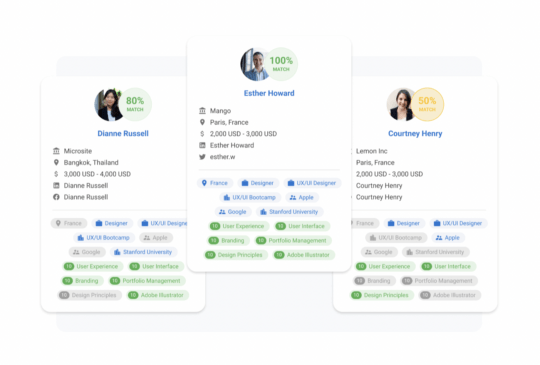
Manatal matching application
Benefits and impact on the recruitment process
The primary objective of using artificial intelligence in recruitment is to minimize time-consuming and redundant tasks so that your teams can spend time on what delivers the greatest added value.
AI serves as a first filter and validates both the technical skills and soft skills of candidates. Thanks to AI, HR professionals can focus on the human element and the candidate’s “fit” with the team and the company.
However, be cautious of bias risk. AI algorithms can reproduce and amplify biases present in training data. It is crucial to monitor and adjust models to ensure fairness and inclusivity.
Application 2: Training and Development
Personalizing training pathways with AI
Thanks to AI, training programs can be personalized according to individual employee needs. Adaptive learning systems can offer specific training content based on employees’ current skills and career objectives, thereby increasing training effectiveness (adaptive learning).
Combined with virtual reality, training can even become immersive to simulate complex scenarios, developing soft skills such as leadership or conflict resolution.
Training platforms and software integrating AI
All LMS (Learning Management System) solutions, such as 360 Learning or Coursera, now integrate AI features. Both to facilitate the creation of training content for companies and to suggest training pathways based on learners’ interests and skills to develop.
The platform TeachUp for example allows real-time adaptation of training content to the learner’s level.
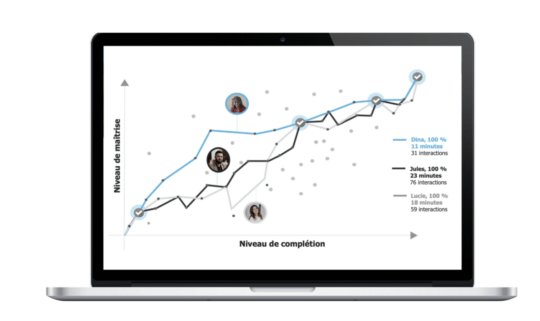
TeachUp graph showing learner proficiency levels
Benefits for employees and the organization
Thanks to the contribution of artificial intelligence, training takes on a new dimension for learners. By being more immersive and personalized, these AI-integrated training programs promote memory and behavioral retention. The results for learners should therefore be better. On this topic, the platforms and software used can also provide personalized summaries of acquired or developing knowledge, allowing learners to retain the essentials and revisit them whenever necessary.
Application 3: Performance Management
Evaluating and monitoring employee performance with AI
Traditionally, performance evaluation relies on annual reviews and subjective opinions. AI can transform this process by making it continuous and data-driven.
Indeed, AI can collect data from various sources, such as task management systems, peer feedback, project results, and even interactions on internal communication platforms. By analyzing this data in real time, AI tools can provide detailed reports on individual and team performance, identifying trends and areas requiring improvement.
Analytics and feedback tools
AI systems can also provide real-time feedback, allowing employees to immediately know how they are performing and where they can improve.
15Five for example enables SMEs to have a real-time view of goal achievement, both individual and collective. Managers can then implement corrective actions to reduce the gap between expectations and reality.
Other tools such as Lattice or Reflektiv also help optimize employee performance by turning employee data into actionable insights.
This continuous approach enables course corrections and supports skills development along the way, rather than waiting until year-end for annual reviews.
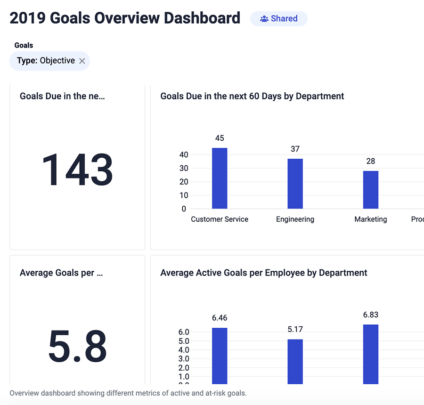
Reflektiv Example
Benefits for continuous improvement and productivity
One of the main advantages of AI is its ability to reduce human biases in performance evaluations. AI algorithms evaluate performance based on predefined criteria and objective data, which enables fairer and more equitable assessments. An employee can thus be evaluated based on their productivity, the quality of their work, and their adherence to deadlines, rather than on subjective impressions from their manager.
By using predictive analytics, AI can identify gaps in employee skills and recommend personalized development plans. These plans can include suggestions for specific training, workshops, or particular projects that will help the employee improve their skills and advance in their career.
Application 4: Talent Management and Workforce Planning
Forecasting skills needs and proactive talent management
AI algorithms can help optimize human resources planning by predicting future workforce needs and adjusting staffing accordingly. This enables better management of activity peaks, absences, as well as other internal and external factors that can impact personnel, thereby ensuring that the company always has the skills necessary for its proper functioning.
AI-based workforce planning software and platforms are being developed in this direction. Examples include:
- The Airudi platform which enables proactive human resources planning based on past and current data, optimizing schedules in real time based on weather conditions, for example.
- The Reflex software which promises to reduce personnel costs and improve business performance through supply chain workload forecasting.
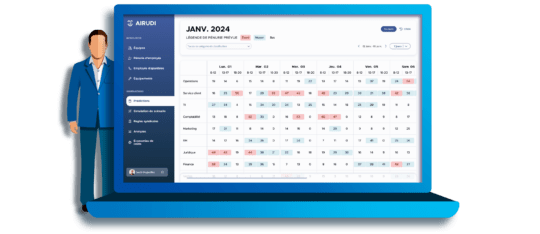
Airudi software showing workforce shortage risks
Impact on HR strategy and talent management
Thanks to software and platforms integrating artificial intelligence for workforce planning, HR teams save time. No more Excel spreadsheets filled with formulas that need constant revision to adapt day by day to constraints (absences, delays, exceptional events…). AI enables more agile, precise, and effective planning. Optimizing planning through AI maximizes resource utilization and therefore minimizes costs.
Application 5: Employee Engagement and Well-being
Monitoring and improving employee engagement through AI
AI can analyze internal communications and employee interactions to assess morale and overall sentiment. Sentiment analysis tools use natural language processing (NLP) algorithms to detect signs of dissatisfaction or disengagement, enabling HR to intervene proactively.
Predictive models can analyze historical data and current trends to identify employees at risk of departure. This enables HR teams to take preventive measures, such as salary increases, promotions, or career development opportunities (training, internal mobility…).
Well-being and mental health applications
AI-based virtual assistants can help employees manage their time, schedule breaks, and set boundaries to maintain a work-life balance that suits them. AI-based time management tools like RescueTime can help employees regain control of their time through automatic tracking that allows them to analyze time spent on different tasks and thus optimize their productivity.
AI-based wellness applications like Joy, can suggest physical exercises, meditation techniques, or stress management workshops tailored to individual preferences and needs. This personalization increases employee engagement and the effectiveness of wellness programs.
Chatbots and virtual assistants can provide immediate support to employees, answering their questions about mental health, company policies, or available support options. These tools can also offer resources and advice based on employees’ expressed needs.
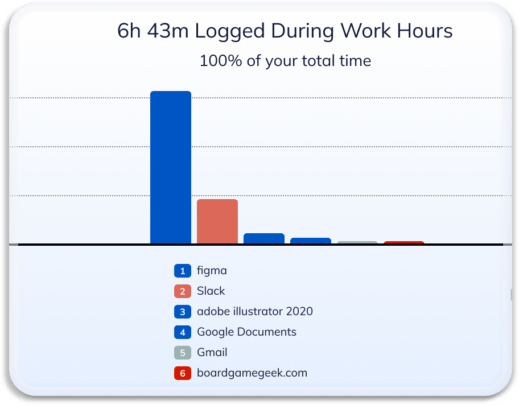
Time tracking example with RescueTime
Return on investment and impact on company culture
AI combined with software can actively encourage employees to adopt practices that improve their level of well-being at work. For example, automated notifications can remind employees to take regular breaks, stay hydrated, or participate in fitness sessions. These small incentives help maintain a healthy and dynamic work environment.
Companies can create a more responsive environment centered on the employee experience, thereby promoting overall well-being and a better quality of professional life, leading to improved productivity.
Application 6: Automation of Administrative Tasks
Automating HR processes
AI can automate repetitive administrative tasks such as timesheet management, payroll, and employee benefits. Systems with integrated AI such as Silae or Payfit for example, can automate the collection, tracking, and calculation of employee working hours. AI-based timesheet management tools can automatically detect anomalies, reduce manual entry errors, and ensure regulatory compliance. Additionally, AI can automate payroll processes, including salary calculations, tax withholdings, and benefits, thus ensuring accurate and timely payments.
HR chatbots like Dydu, can answer employee questions, book leave, and provide information about company policies. These systems can process requests, check available leave balances, and automatically update calendars. They can also inform managers of planned absences and ensure that teams are properly scheduled.
AI can also automate the management of administrative documents, including the creation, storage, and retrieval of files. AI systems can automatically classify documents, extract relevant information, and facilitate their search, thereby reducing the time and effort needed to manage documentation.
Finally, AI tools can monitor compliance with regulations and internal policies by analyzing data and generating compliance reports. They can also alert HR managers in case of non-compliance, enabling rapid corrective action.
Time savings and efficiency gains for HR teams
By automating these administrative tasks, AI enables HR teams to gain efficiency, reduce errors, and dedicate more time to strategic initiatives, such as talent development and company culture improvement.
Application 7: Predictive and Decision-Making Analytics
Using AI for advanced analytics and forecasting
AI can be leveraged to support HR decision-making in recruitment, career management, and risk management.
AI algorithms can analyze labor market trends, company growth rates, and turnover histories to predict future staffing needs. By anticipating skills shortages and recruitment needs, HR teams can plan more effectively and launch proactive recruitment campaigns.
AI tools can also evaluate employee performance data, identify trends, and predict departure risks. For example, by analyzing performance histories, feedback, and employee satisfaction data, AI can identify those at risk of resignation and recommend preventive actions, such as salary increases or development opportunities.
AI can analyze the skills, experiences, and aspirations of employees to recommend optimal career paths. Using predictive models, HR can identify the best candidates for internal promotions, plan personalized training programs, and align employees’ career objectives with the company’s strategic needs.
AI systems can also analyze compliance data, incident histories, and safety reports to identify potential risks within the company. Predictive analytics can help prevent issues before they arise, alerting managers to areas requiring particular attention.
Influence on strategic decision-making and resource optimization
AI enables HR to make informed decisions by providing data-driven insights. Interactive dashboards and AI-powered data visualizations offer an overview of key indicators, facilitating trend analysis and identification of improvement opportunities.
AI enables HR to shift from a reactive to a proactive approach, using predictive and decision-making analytics to optimize talent management and improve organizational performance.
Conclusion
Beyond all the applications we have discussed, AI is transforming the role of HR professionals by encouraging them to become talent strategists rather than mere administrators. In the years to come, HR professionals will no longer be able to do without AI-based tools to be more effective. Data analytics and change management skills are thus becoming increasingly important in this field.
Integrating AI into HR therefore requires technical expertise and a deep understanding of human dynamics. Engaging an outsourced HR Director can be the ideal solution to fully leverage the benefits of AI. Outsourced HR Directors bring specialized expertise, fresh perspectives, and tailored solutions to address your company’s unique challenges. They can help deploy AI technologies effectively and ethically, while ensuring compliance with labor regulations.